Something has shifted in San Francisco. You can feel it before you can cite it. The restaurants in Hayes Valley and the Presidio are harder to get into. The coffee shops in Mission Bay are full by 8am on a Tuesday. And when we hold an open house in Pacific Heights or Cow Hollow, the energy in the room is different from what it was two years ago.
A lot of that energy has a name: artificial intelligence. And the last six weeks have made it undeniable.
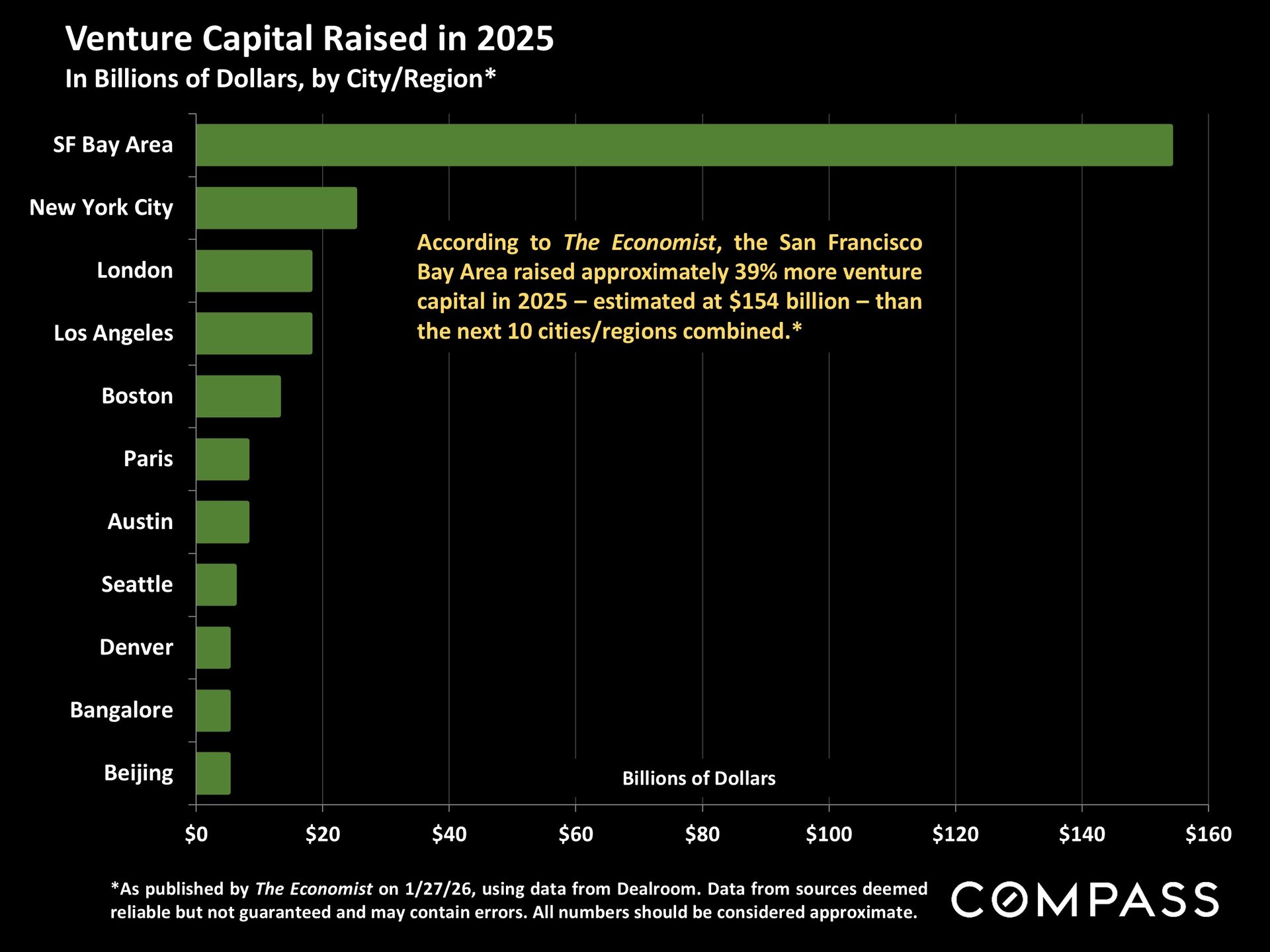
Source: Compass Market Report, March 2026. Data via The Economist / Dealroom.
The SF Bay Area raised $154 billion in venture capital in 2025, roughly 39 percent more than the next ten cities in the world combined. That capital does not stay abstract for long. It flows into hiring, into office leases, and eventually, into real estate.
The deals happening right now tell the story directly. Anthropic recently signed a lease for the entire building at 300 Howard Street, one of the largest office commitments SF has seen since the pandemic. Microsoft is bringing two of its biggest conferences back to the city. Citywide office leasing hit a six-year high in 2025, driven by major moves by OpenAI, Sierra AI, and Nvidia. The talent is here. And they need somewhere to live.
The connection from tech wealth to residential real estate is no longer theoretical. We are seeing it in the room. The buyer profile has shifted. More clients with AI-company equity, more people who have recently relocated for a role and are done renting, more offers written quickly and with conviction.
The market has been heating up since fall 2025, but the last six weeks have been on a different level. Inventory is down 29 percent from this time last year. The absorption rate in February 2026 was 60 percent higher than February 2025. Demand came back fast, and supply did not keep up.
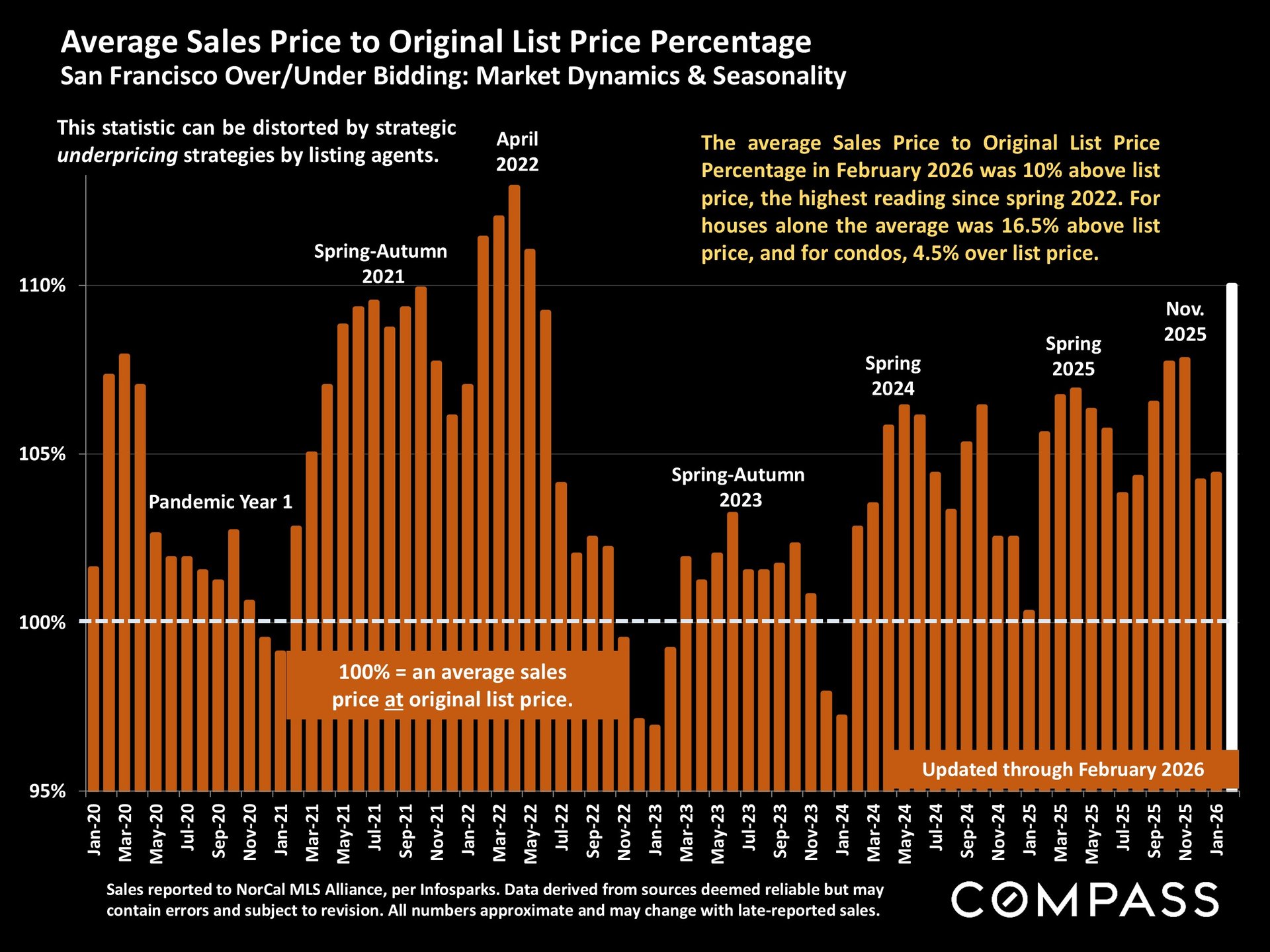
Source: Compass Market Report, March 2026. Sales reported to NorCal MLS Alliance, per Infosparks.
In February 2026, the average home sold at 10 percent above its original list price, the highest reading since spring 2022. For houses specifically, that figure was 16.5 percent over list. That is not a market where buyers are negotiating. That is a market where buyers are competing.
Supply vs. demand readings for 2- and 3-bedroom houses are at 0.8 months of inventory. The buyers winning right now are the ones who came in with a clear head and a solid strategy.
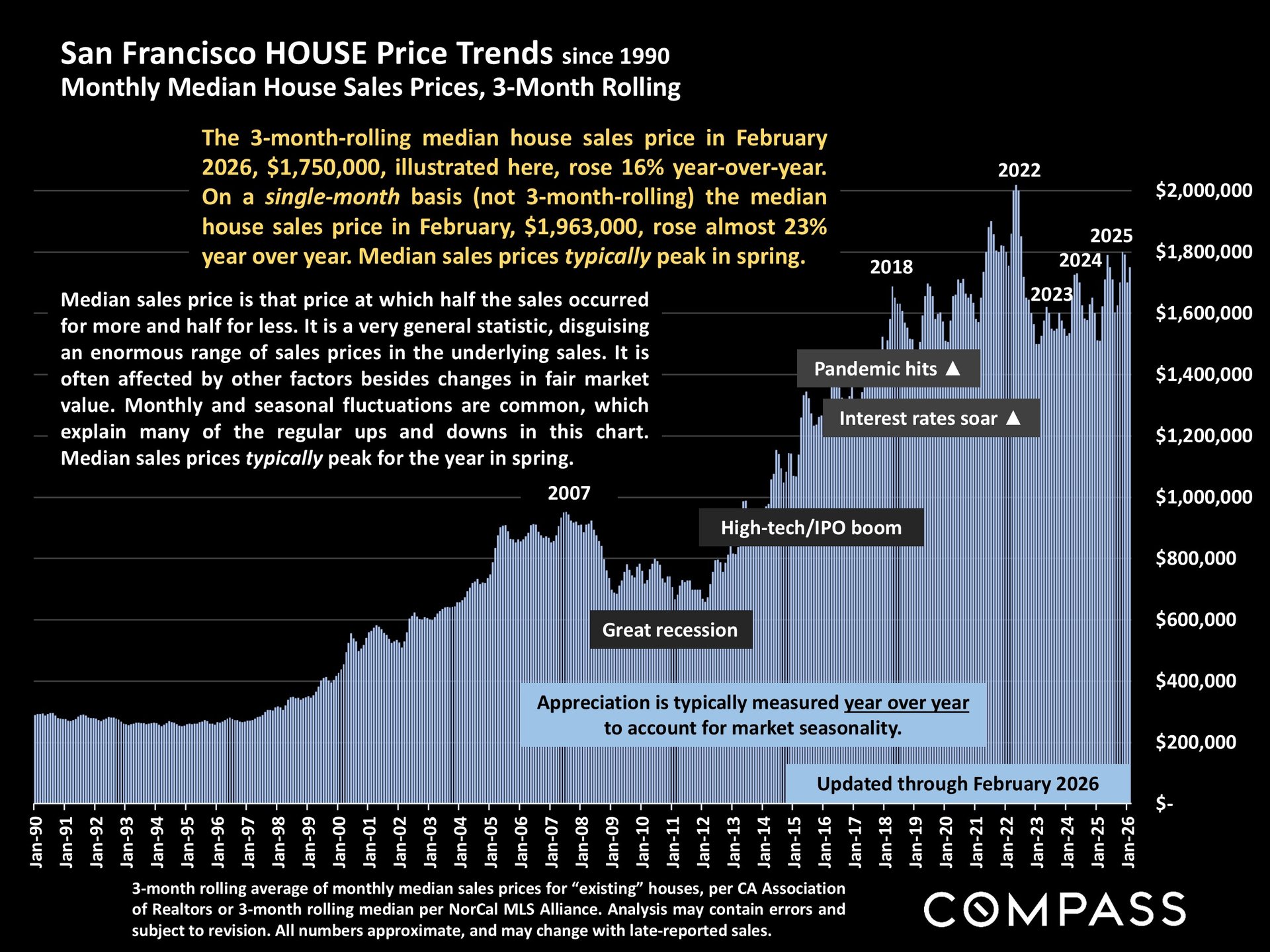
Source: Compass Market Report, March 2026. CA Association of Realtors / NorCal MLS Alliance.
The three-month rolling median house sales price in San Francisco reached $1,750,000 in February 2026, up 16 percent year-over-year. On a single-month basis, the February median was $1,963,000, up nearly 23 percent year-over-year. The chart above puts the current moment in perspective, including where we sit relative to the 2022 peak and the post-rate-hike correction.
The larger the home, the stronger the appreciation. The data show that 4,000-square-foot-plus houses appreciated 16 percent per square foot in value from 2024 to 2025. This is consistent with what we are seeing: the buyers entering the market right now are not looking at starter properties.
We are not suggesting the picture is uniformly rosy. The broader office market is still working through significant vacancy. Not every neighborhood is recovering equally. And spring inventory is expected to rise, which may temper some of the competition currently concentrated in a very thin market.
But for buyers and sellers of well-positioned homes in San Francisco right now, the direction is clear. The people asking whether the momentum is real are increasingly deciding that it is. And the data from our own Compass analysts, updated through this month, supports that read.
If you have been curious about how any of this affects your own situation, we are always glad to talk through it.
Sources: Compass Market Report, March 2026 | CBRE via Bisnow | SF Standard: Year It Became Cool to Bet on SF | SF Standard: Boom Loop Watch 2026
Compass
891 Beach Street
San Francisco, CA 94109
Erin Thompson | CA DRE# 01777525
Erin Thompson & Team